Back to Portfolio
Event Planning AI SaaS

Plan Any Event Without a Planner

An AI-powered event management system that replaces the €8,000–€25,000 professional planner with smart budget tracking, supplier coordination, and timeline automation—so anyone can plan like a pro.

Role

UX/UI Designer

Duration

7 Weeks

Tools

Figma, FigJam

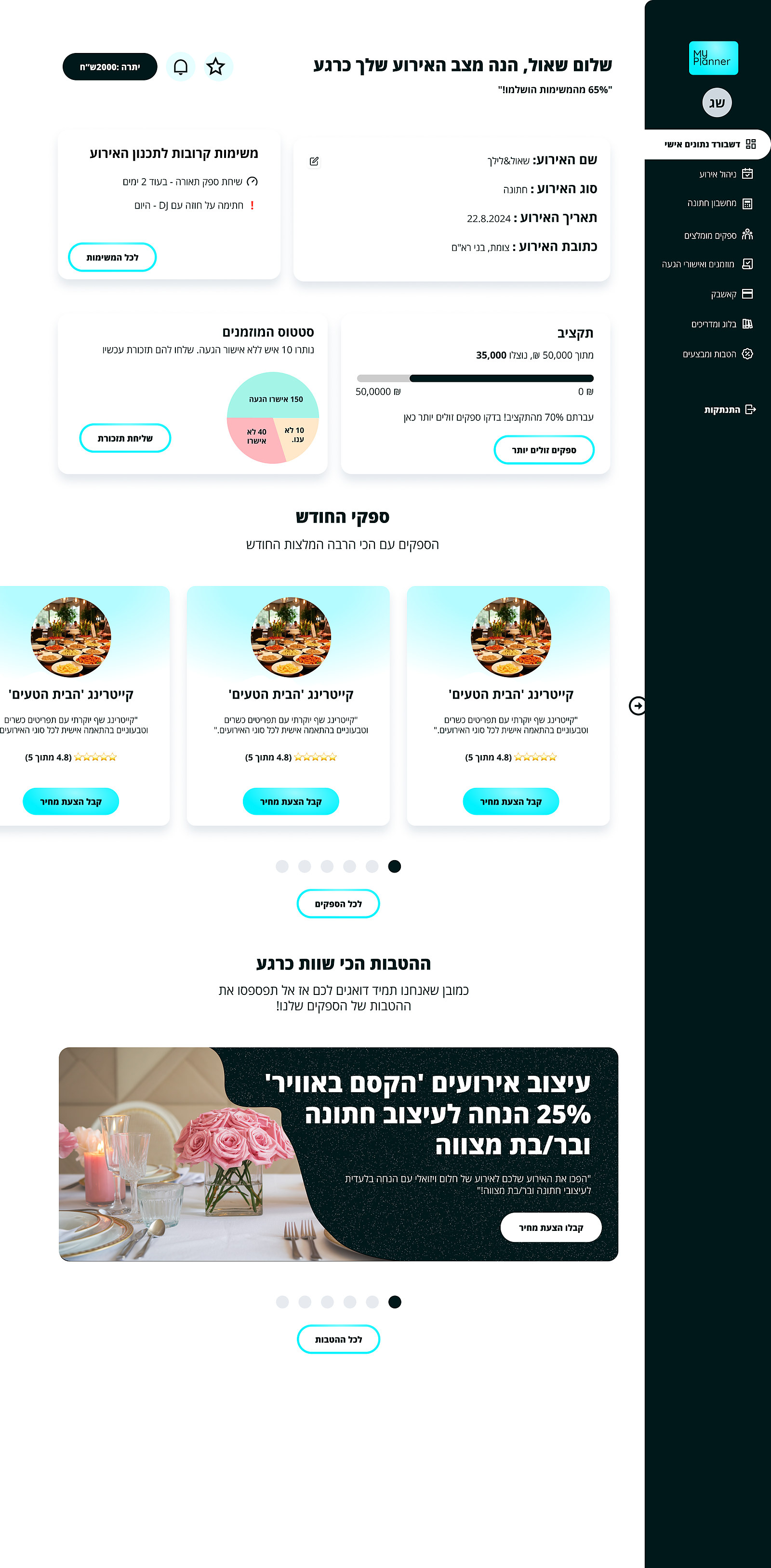
MyPlanner Dashboard
MyPlanner Budget Calculator
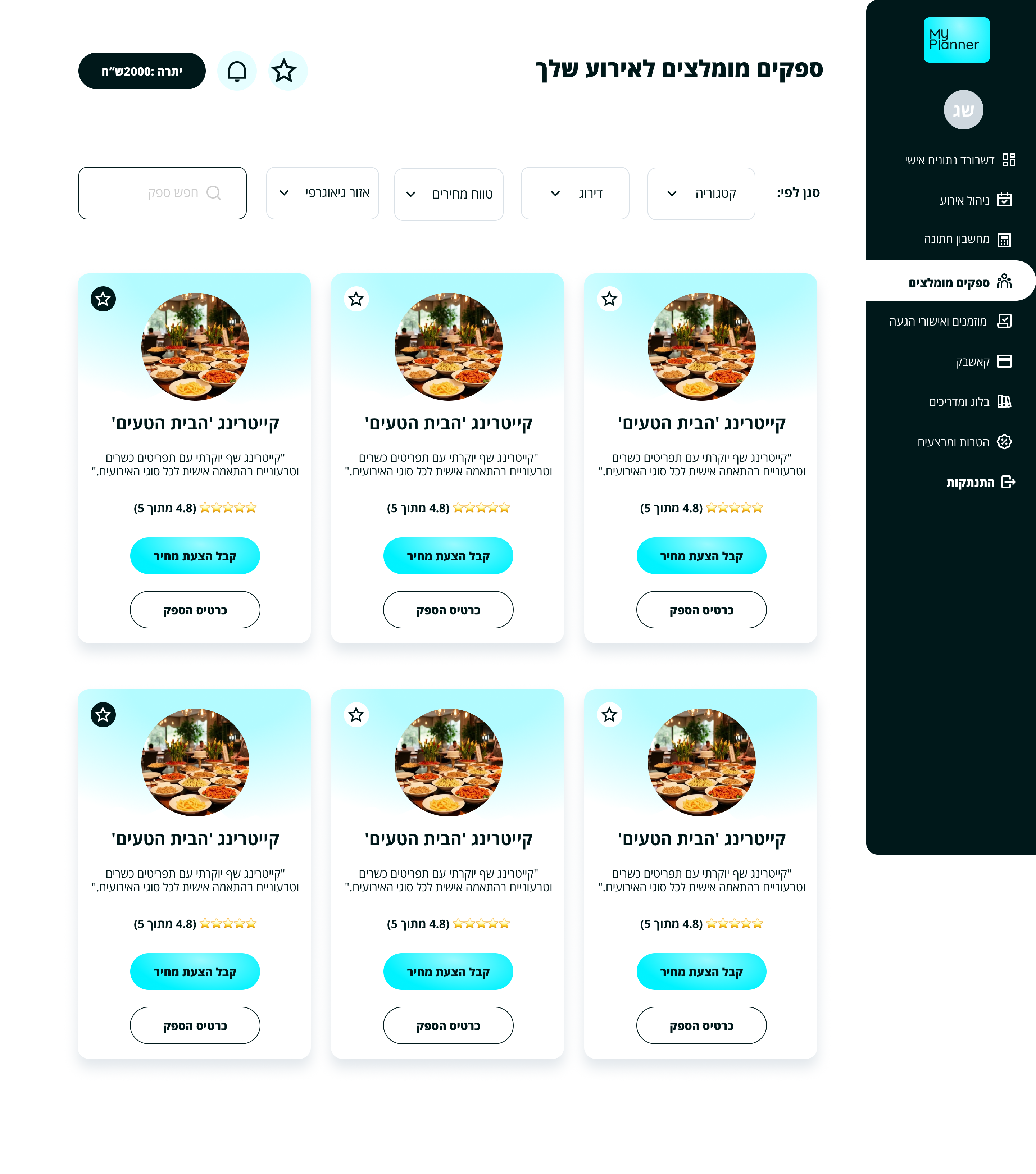
MyPlanner Suppliers
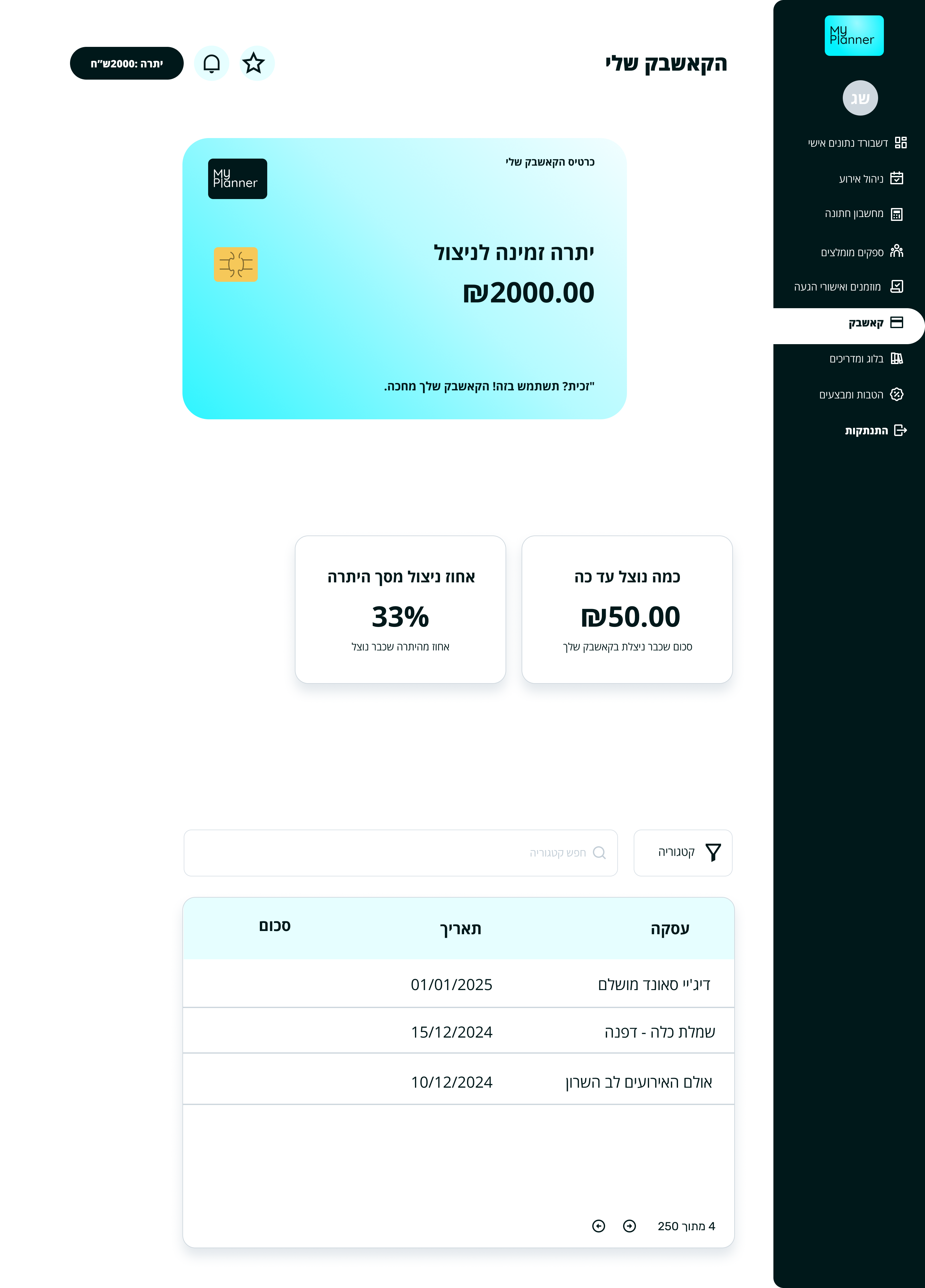
MyPlanner Cashback

The Planning Chaos

Planning an event—a wedding, bar mitzvah, or corporate gathering—is one of the most stressful experiences in people's lives. With 15+ suppliers to coordinate, 150+ decisions to make, and budgets that spiral out of control, most people are drowning in WhatsApp groups, scattered spreadsheets, and forgotten deadlines.

The alternative? Hiring a professional event planner costs ₪8,000–₪25,000. That's why 78% of people plan events without professional help—not because they don't need it, but because they can't afford it. MyPlanner fills that gap: AI-powered guidance at a fraction of the cost.

Turning Chaos into Clarity

MyPlanner is an AI-powered event management platform that handles the complexity so planners can focus on the celebration. From an initial questionnaire to the final payment, every step is guided, organized, and optimized by intelligent automation.

Design Journey Roadmap

Interviews
Event planners
Affinity Map
Clustering insights
Empathy Map
User emotions
Pain Points
Core frustrations
HMW
Reframing problems
Hi-Fi Design
Final UI

Research Goals

I interviewed 18 people who planned events in the past year—weddings, bar mitzvahs, corporate events, and birthday parties—to uncover the core frustrations driving event planning failure.

01 Understand how people currently track and manage event budgets, where breakdowns occur, and what triggers budget overruns—so we can design an AI-powered budget system that prevents overspending before it happens.
02 Map the full lifecycle of how users find, evaluate, book, and pay suppliers—identifying the friction points where miscommunication, forgotten details, and missed deadlines most commonly occur.
03 Determine what level of AI guidance users need at each planning stage—from "tell me what to do next" to "validate my choice"—so we can calibrate the assistant's proactivity without overwhelming users.

What We Heard

Key insights from 18 interviews, clustered into four themes that shaped every design decision.

Budget Chaos
"I had 47 tabs open trying to compare venue prices"
"My budget spreadsheet was a nightmare — I didn't know how much I actually spent until it was over"
"We went ₪40,000 over budget without realizing it"
"Deposits, final payments, extras — I lost track of who I owe what"
"I need a system that yells at me before I overspend, not after"
Supplier Stress
"I forgot to confirm the photographer and almost lost the booking"
"The DJ showed up at the wrong time because we miscommunicated on WhatsApp"
"I don't even know what questions to ask a florist vs. a caterer"
"Where did I save that quote? Is it in email, WhatsApp, or the folder on my desktop?"
"Comparing 5 photographers side by side was impossible"
Time & Deadlines
"Popular venues book 12–18 months in advance — I learned that too late"
"I wish something would just tell me what to do next"
"We planned for 8 months and still felt behind"
"Sending final guest count to the caterer almost slipped through the cracks"
"I didn't know that I needed to book the makeup artist 6 months out"
Emotional Toll
"Planning my wedding was supposed to be fun — it was the most stressful 10 months of my life"
"My partner and I had 3 serious fights about budget"
"I couldn't afford a planner but I clearly needed one"
"The 150+ decisions made me want to cancel everything"
"By the end I just didn't care anymore — whatever, just pick one"

Core Pain Points Identified

Planning Stress & Anxiety
96%
Budget Overflow
73%
Supplier Miscommunication
62%
Decision Fatigue
47%
Payment Tracking Confusion
41%
Missed Tasks & Deadlines
34%

Narrowing Down the Problem

Problem & Hypothesis Statement

After mapping frustrations and clustering insights from interviews with Israeli couples, a clear pattern emerged. Despite different budgets, venues, and guest counts, every couple described the same underlying struggle. At this stage, I needed to sharpen everything into a single design challenge — the Problem Statement.

Couples planning weddings in Israel face fragmented tools, hidden costs from suppliers, budget overruns, and stress from managing everything manually across spreadsheets, WhatsApp groups, and vendor calls. They need a unified system that tracks every shekel, centralizes supplier communication, and provides smart guidance — replacing the ₪8,000–₪25,000 wedding planner with an affordable AI-powered alternative.

Building on the problem statement, I translated the core challenge into a testable assumption — the Hypothesis Statement — that could guide design decisions and later be validated with users.

If

we build an all-in-one wedding planning platform that centralizes budget tracking, supplier management, and task coordination with AI-powered recommendations and real-time cashback tracking

then

couples will feel confident and in control throughout the planning process, reduce budget overruns by up to 40%, and enjoy the journey instead of dreading each decision — all without hiring an expensive professional planner

A Day in the Life

To truly understand where the pain lives, I mapped out a typical week for a couple planning their wedding in Israel — from the excitement of getting engaged to the exhausting reality of juggling suppliers, payments, and an ever-growing to-do list.

The Reality Today

The couple starts excited but quickly drowns in fragmented tools — a shared Google Sheet for budget, WhatsApp groups with each supplier, Pinterest boards for inspiration, and a notebook of scribbled phone numbers. Every payment requires manual tracking, every vendor quote lives in a different chat thread, and by month three they're arguing about money they can't account for. The ₪8,000+ professional planner feels like the only escape, but most can't afford it.

The Vision

A single app where every budget line item, supplier conversation, payment receipt, and milestone lives in one place. AI recommends suppliers based on budget and style, alerts when spending exceeds category benchmarks, and breaks the overwhelming 250-task checklist into a manageable daily plan. Cashback rewards turn smart decisions into real savings.

Venue Hunting
Budget Setup
Supplier Search
Booking & Deposits
Payment Tracking
Final Countdown
Action
Visit 5–8 venues, compare pricing packages, negotiate with venue coordinators
Try to set a total budget and allocate across 12+ categories (venue, catering, photography, DJ, flowers, dress, etc.)
Search for suppliers via Instagram, recommendations from friends, and wedding Facebook groups
Sign contracts, pay deposits, track who received what amount and when the next payment is due
Manage 20–30 separate payments across 15+ vendors over 8–12 months
Confirm all vendors, finalize seating, coordinate day-of timeline with every supplier simultaneously
Task List
A. Research venues online and collect phone numbers

B. Schedule visits and take notes at each one

C. Compare pricing across venues with different package structures
A. Google "average wedding cost Israel" to set expectations

B. Create a spreadsheet with categories and estimated costs

C. Argue with partner about priority allocation
A. Ask married friends for recommendations

B. Browse Instagram portfolios and collect contacts

C. Request quotes from 3–5 suppliers per category and compare
A. Review contracts (often in Hebrew legal language)

B. Transfer deposits via bank or Bit app

C. Save receipts in a folder or screenshot thread
A. Check spreadsheet for upcoming payments

B. Manually update paid amounts after each transfer

C. Cross-reference bank statements with supplier agreements
A. Create a WhatsApp group with all vendors for day-of coordination

B. Build a timeline from scratch

C. Handle last-minute changes and cancellations
Feeling
Excited, dreaming big
Overwhelmed — no idea what things should cost
Frustrated — too many options, no way to compare objectively
Anxious — large sums leaving the account with no clear tracking
Stressed — lost track of who was paid and how much remains
Exhausted and panicked
Opportunities
Curated venue suggestions based on budget, location, and style preferences
AI-powered budget allocation with market benchmarks for each category
Supplier marketplace with ratings, verified pricing, and side-by-side comparison
Digital contract storage, deposit tracking, and automated payment reminders
Auto-syncing payment tracker with color-coded status and cashback rewards
AI-generated day-of timeline with vendor coordination and real-time updates
Crafting a Tool That Cuts Through the Chaos

From research insights, I framed the core design challenges as "How Might We" questions:

Budget Control

How might we make budget tracking feel effortless so couples always know exactly how much they've spent, committed, and have remaining?
How might we surface fair market pricing at the moment of decision so first-time planners never overpay?
How might we replace the ₪8,000+ professional planner with AI guidance that provides the same structured budget control?

Supplier Management

How might we reduce supplier miscommunication by centralizing all vendor conversations, contracts, and deliverables in one hub?
How might we help couples compare suppliers objectively with ratings, pricing, and verified reviews?
How might we automate payment tracking across 15+ vendors so no deposit or deadline is ever missed?

Stress Reduction

How might we transform the overwhelming 250-task checklist into a personalized, bite-sized daily plan?
How might we give couples a clear sense of progress so they enjoy planning instead of dreading it?
How might we use AI to anticipate what couples need next, reducing decision fatigue at every step?

Turning Insights Into Action

With six clear pain points and a validated cost gap, I designed each screen to directly address a specific frustration—replacing scattered tools, expensive planners, and manual tracking with one intelligent system. Every screen was crafted to reduce planning anxiety and build confidence.

From Flow to Experience

Before designing screens, I mapped the ideal user flow and journey — ensuring every step feels intuitive and every emotion is accounted for.

Simple User Flow
The core navigation path through MyPlanner — from login to cashback
Login
Dashboard
Budget Calculator
Supplier Search
Supplier Profile
Book & Pay
Cashback Track
Review
User Journey Map — Close Up
Focused on the product — from first open to full budget control
Opens the app for the first time Sets up their event & budget Browses supplier marketplace Books vendors & tracks payments Monitors progress & cashback
Action Noa and Amit open MyPlanner after getting engaged Enter event details, set total budget, and let AI allocate across categories Search for photographers, caterers, DJs — filter by price, rating, location Book suppliers, sign contracts digitally, and schedule installment payments Track spending vs. budget, see cashback balance grow, review AI suggestions
Feeling Overwhelmed — where do we even start? Cautiously hopeful — the numbers feel real now Curious but indecisive — so many options Relieved — everything is tracked automatically Confident and in control — enjoying the process
Opportunities Warm onboarding, guided event setup, calming UI Market benchmarks, AI allocation, visual budget breakdown Side-by-side comparison, verified reviews, "couples like you booked" nudges Digital contracts, auto payment reminders, receipt photo capture Progress celebration, cashback milestones, proactive AI alerts

Event Dashboard

The home screen answers the three questions every planner has: how's my budget, what's coming up, and which suppliers need attention. A single glance replaces the 47-tab chaos that users described in research.

  • Event status header — event name, type, date, venue, and guest count with a progress bar showing 65% completion
  • Budget at a glance — visual breakdown of ₪50,000 total with ₪35,000 spent, so users always know where they stand
  • AI recommendation — "70% of couples in your range also booked..." nudges users toward smart next steps
  • Top suppliers — featured vendors with ratings, pricing, and one-tap "Get Quote" to reduce supplier search friction
MyPlanner event dashboard with budget overview and recommended suppliers

Smart Budget Dashboard

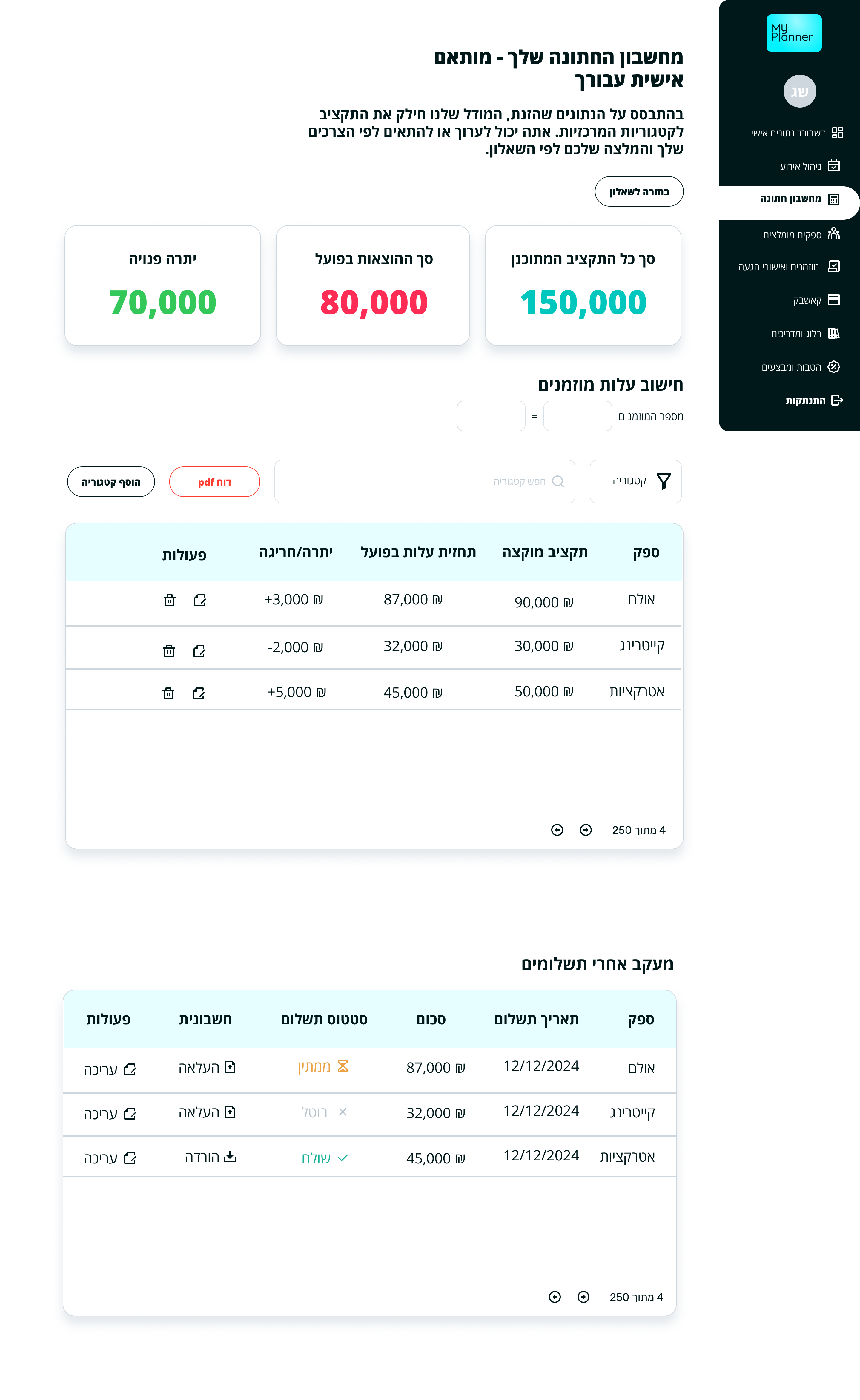
The #1 pain point: 73% of planners exceed their budget. This dashboard uses a three-state model—spent, committed (deposits), and remaining—to prevent the false sense of security that causes overspending.

  • Donut chart — visual split of spent vs. committed vs. remaining budget at a glance
  • Category breakdown — venue 40%, catering 25%, photography 10% with market benchmark comparisons
  • AI alerts — "You've allocated 45% to venue—typical is 35–40%. Consider adjusting catering budget"
  • Quick-add expense — receipt photo capture with AI extraction reduces manual data entry friction
MyPlanner budget dashboard showing ₪150,000 budget calculator and payment tracking

Supplier Management Hub

62% of planners reported at least one major supplier miscommunication. This screen centralizes all vendor relationships—from first contact to final payment—into a single source of truth.

  • Status pipeline — supplier cards organized by stage: Researching, Contacted, Booked, Paid
  • Integrated messaging — WhatsApp, call, and email actions directly from each supplier card
  • Contract storage — eliminates "where did I save that quote?" with per-vendor document upload
  • Comparison view — side-by-side pricing and features for same-category suppliers to reduce decision fatigue
MyPlanner supplier management with catering cards, ratings, and price quotes

Payment Tracker

With 20–30 separate payments across 15+ vendors, 41% of planners lose track of who they owe and when. This tracker brings all financial obligations into one color-coded view.

  • Color-coded status — green (paid), yellow (upcoming), red (overdue) for instant urgency recognition
  • Calendar view — payment due dates mapped to a timeline so users can plan cash flow
  • Live totals — total paid vs. total remaining budget displayed at the top, always visible
  • Receipt upload — proof of payment per vendor prevents disputes and enables reconciliation
MyPlanner cashback and payment tracker showing ₪2,000 balance and transaction history

Final Thoughts

What I Learned

  • The cost gap is the core value. The difference between ₪8,000–₪25,000 for a human planner and ₪50–₪150/month for MyPlanner is transformational. 78% of people plan without help because they can't afford it, not because they don't need it.
  • Budget tracking fails because of input friction. Spreadsheets exist. Apps exist. People still overspend because every tool requires manual entry across 15+ vendors over 12 months. The winning design reduces input to near-zero: receipt photos, AI extraction, auto-categorization.
  • AI value peaks at "what should I do next?" Users don't need AI to add numbers. They need AI when staring at a blank screen thinking "I just got engaged, now what?" The AI must be a proactive advisor, not a passive assistant.

What I'd Do Differently

  • Run a diary study, not just interviews. Event planning unfolds over 8–14 months. One-time interviews capture recalled pain points, not real-time frustrations. A 3-month diary study would surface the exact moments where tools fail.
  • Test AI trust thresholds earlier. How much do users trust AI for high-stakes decisions like booking a ₪40,000 venue? I'd run concept tests with realistic AI recommendations to find the trust boundary before building the full feature set.
  • Include co-planners in research. Event planning is rarely solo — it's couples, parents, or committees. The research focused on primary planners, but coordination between co-planners deserves its own feature set (shared access, decision voting, activity log).